Tuesday, March 3, 2015

Book Analysis 2: I Am the Cheese

Robert Cormier’s I Am the Cheese is technically listed as a crime novel. The book is written in parallel narratives—one a first-person account of a boy running away to visit his father, and the other written as a transcript of therapy/interrogation sessions. The story covered in the transcript grows with gripping intrigue as Adam learns that his life is nothing that he thought it was, and that he is not the person he believes he is either. The unfolding of this grand scheme of organized crime, hidden identity, and a search for justice is exciting and will extend the imagination of readers. However, more valuable is the other narrative—a smaller, simpler story of one boy’s attempt to faces daily fears and anxieties. Life is hard, and disenchantment understandable. This story emphasizes that daily challenges are often the most frightening, forcing the struggles of the real world on the reader. However, by placing this next to a narrative that is on a much grander level Cormier paints these mundane struggles as noble and validates their difficulty.

The opening scene in the novel is one that many children have experienced—the exhilarating and terrifying feeling of riding quickly on a bike. Adam has thirty-five dollars, a dilapidated bike, and he didn’t take his medication that morning. This moment illustrates the extent of power children can create, and the simultaneous fear it creates. The next chapter introduces the next narrative—the transcript—and immediately that narrative is imbued with a feeling of spookiness, urgency, and panic. Adam recalls he and his father running away, and they don’t even know what from. These first two scenes, despite their differences in scale and tone, connect to each other in many ways. First, there is the feeling of running away from something you don’t understand. In the transcript that is played out quite literally. In the narrative, however, it is more cloudy and consequently more true to life. Adam thinks of everything he is leaving behind—a bad grade, his isolating interest in  Thomas Wolfe, his exciting but nervous relationship with Amy, and his dependence on medication. These fears look miniscule compared to the menacing threat that causes his family to flee in the other narrative, but because they are placed next to each other means that the same tone is applied to each.

This pattern continues throughout the book. When, in the transcript, Adam discovers that his family has a hidden identity and that he is, in fact, Paul Delmonte, the next thing that happens in the narrative is Adam realizing his bike has been stolen. Again, comparatively a stolen bike is miniscule in the context of lies and alternate identities, but the parallel pattern of the narrative validates the urgency of the stolen bike. For a child, the fear of a stolen bike is very real—as real as the secrets of the Farmer family. As another example, when Adam and his family again are forced to run toward the end of the book, the story happening in the other narrative Adam arrives in Belton Falls and experiences the fear of being there alone, at night, with strangers all around. The uncertainty in both of these events is the same.


At the end of the book these narratives meet together. In the story told through the transcript, Adam reveals that his parents were murdered (though it was staged to look like a car crash). The illusion surrounding the other narrative is then broken, and the adventure Adam has been experiencing is less exciting than ever—he has just been acting out his own delusions. However, the tragic solitude cause by his parents’ murder is here paralleled with Adam’s discovery that he “is the cheese”—a reference to the song “The Farmer in the Dell” and the line “the cheese stands alone.” Adam realizes that he is alone and has nobody. It’s a tragic end. The book does not soften the blow, but lets this loneliness stand. The hardships of the exciting crime story Adam reveals then pale in comparison to the realization everyone ends up having in life—that they are the cheese.

Saturday, February 28, 2015

Film Analysis 2: Mon Oncle

From the very opening of the film it is apparent that Jacques Tati’s Mon Oncle is not going to follow the standards of comedic filmmaking. The comedy is set in a world of heightened reality, where one side of the town is an idyllic picture of rural France, and the other is the most “modern” neighborhood around, featuring architectural novelties and everything plastic. As the antics play out in a relaxed pace, the bounds of standard narration don’t impede on the pleasure of the story—character focus is fluid, and goals are just passing fancies. Through sound and dialogue, unique cinematography, and manipulation of setting, the experimentation in the film Mon Oncle reflects its theme that natural experimentation and mischief can bring family closer together.  

The sounds in Mon Oncle indicate the modern versus the organic, or in other words the bad and the good, and cue the audience to appreciate rural mischief of Hulot’s world over the rigid order of Arpel’s. Only when the scene is with the Arpels and their modern world are there obviously contrived sound effects featured, such as the fountain, the doorbell, and the breathing sounds in the factory. In Hulot’s neighborhood there is music and the organic sounds of birds tweeting and children laughing—as well as dialogue, which is treated as just another sound. The film uses this vague sound to draw attention to the mischief that is developing Hulot and Gerard’s relationship.
Additionally, the other sounds of the film consistently compete with the dialogue and often have more to do with the story at hand. For example, the obnoxious sound of water trickling from the fish fountain indicates the Arpel family’s pride and control. During the dinner party Hulot manages to break the fountain, and the trickling is even more chaotic and distracting than normal. This reflects the fact that Hulot is bringing in the organic mess of his world into the Arpel’s home—though in the last scene of the film it’s clear that this chaos will create a relationship between father and son. On the reverse, when Monsieur Arpel brings his fancy new car into Hulot’s neighborhood, the music that has always accompanied that area is, like the fountain, halted and restarted again and again as Arpel tries to parallel park his car between two carriages. The car is unwelcome in this world of fun, and the obsessively methodical way Arpel is parking is interrupting the natural pleasure of life.


Mon Oncle is told visually, and consequently the cinematography does its part in non-traditionally communicating comedy. The film does very little to methodically draw audience attention to certain elements, but rather lets the audience play with their own attention like Gerard playing with the village children. First, most of the shots are extremely wide, and from interesting angles. Rather than shooting things for their aesthetic appeal, Tati angles the camera in order to capture the most action possible for the longest amount of time possible. In one long shot the audience can see the entirety of Hulot’s apartment building. The shot lasts as long as it takes for Hulot to climb up the chaotically designed building to his own room. The film lets the audience follow their own interests in the scene. Consequently, the film plays out more like a comic strip—a frame of visuals plus a few sound effects—rather than a narrative film.


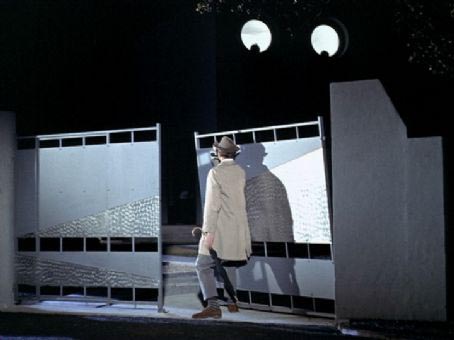
Lastly, Mon Oncle experiments with its environment, and combines tdiegetic and non-diegetic elements to create an atmosphere of mischief and fun. One notable moment is when Hulot is trying to finish trimming the bush, and wakes up the Arpels. The Arpel’s heads are silhouetted in their ultra-modern windows, making is appear as if the house has eyes and their heads are the pupils. They move in unison and consequently the house “looks around.” Hulot’s interaction with the environment is the most comedic element, such as when he is trying to use the kitchen. As mentioned before, the opening credits are all written on elements of the environment—signs and chalk drawings. This combination of diegetic and non-diegetic breaks the rules of traditional storytelling and reminds the audience that they are watching a constructed reality.


In the end, when Gerard and his father enjoy the results of a prank, Gerard grabs his father’s hand in a moment of affection. All of these moments that experiment with film form lead the audience to understand that this humor and clumsiness are what brought the family together.

Tuesday, February 24, 2015

Online Response #5 - Alice

As a long-time lover of Alice’s Adventures in Wonderland and Lewis Carroll’s other stories, the horror displayed in many adaptations bother me. A statement against rigid Victorian upbringings, political structure, and a reaction to Lewis Carroll’s life of mathematical order an inexplicable health issues, the chaos and nonsense depicted in the Alice stories is simply a reflection of real life. However, most modern interpretations push a horror or sexual element on the narrative, insisting that nothing could make so little sense and not be the product of a deranged mind. But when looked at closely, Alice’s reactions to everything that happens do not suggest any sort of confusion or horror. Rather, the nonsense depicted in the stories is a natural element of Alice’s imagination and the world she inhabits, and does contain a sort of order—though perhaps not an order immediately apparent to an adult mind. Jan Svankmajer’s Alice reflects the chaos of a child’s imagination, the way imagination is a means to experience, and the way a child can “link his imagined objects and situations to the tangible and visible things of the real world,” as Freud describes.

The design of Alice’s entire world is completely based on the “tangible and visible things” which Alice interacts with in everyday life. The infamous White Rabbit is made out of taxidermy display in her own home, whereas the Caterpillar is made out of a sock and some false teeth.  Though perhaps the reason this film comes off as surreal and creepy as it does, it is also the result of a child naturally reacting with the world around her. When Alice “wakes up” at the end of her adventure, she is just home again (though with tiny bits of evidence that something fantastic may have happened—namely, the rabbit is still gone). This is much like Winsor McCay’s Nemo in Slumberland comic strip. At the end of each installment there is a frame depicting was is “really” happening as Nemo has these adventures: he is in bed, usually in some sort of ridiculous position, evidence of his play. Nemo has combined the world around him (his bed and bedroom) with his own imagination in order to create what Freud calls “phantasying.” So, while sock worms might not make any sense to a rational adult, this combination of real-world objects and Alice’s imaginary nonsense is a great representation of child’s play.

Next, while it may not be rational, there is still an order to the world Alice creates.  The structure of Jan Svankmajer’s adaption follows a very specific pattern: Alice finds a drawer, pries it open, and is then somehow ushered into the next part of her adventure. The ink and tarts also are part of Alice’s manufactured order—they’re simple cause and effect.

The manufactured order of the story brings me to my next point: Alice’s adventure is, as we discussed in class, a means for her to gain experience and sort out her own goals, fears, and desires. Alice is undeniably resourceful, brave, and stalwart as she experiences all sorts of obstacles. In this reality, Alice always has a way to solve her next problem, such as a convenient bit of tart that can cause her to grow or shrink as needed. This story reflects Alice’s desire for control and bravery in a world which likely doesn’t make any sense to her.


Overall, it isn’t too much to think that a surrealist reality makes a lot of sense to a child such as Alice. The found-object design of the story, the manufactured order, as well as the way the story creates an experience for Alice, all reflect how Alice displays the chaos of imagination and psychological need it fulfills.

Tuesday, February 10, 2015

Online Response #4 - Not One Less

The hardship experienced by Wei Minzhi and her little class in the docudrama Not One Less portrays real-life experiences with the triumph and hopefulness that is inherent to children. As discussed in class, this children’s media serves as documentation by not representing trials through fantasy or metaphor, but by using the real world. However, as big and as scary as this world is, Wei proves that she has some sort of command over the world. As Hushpuppy insists in Beasts of the Southern Wild, despite all odds, “We’s who the earth is for,” Wei also portrays a tenacity and determination that she belongs in the world and that her journey is one that deserves attention.

Unlike the films that we’ve watched previously, Not One Less is focused on work and productivity. Wei, though only thirteen, has a job and has a primary concern with earning money and doing her job in a way that would make Teacher Gao proud. However, the film celebrates this labor. The most exciting and interesting moments of the film revolve around it—for example, the children have huge amounts of fun when they go and visit the brick factory and move the bricks. Later on, even when they’re in school, the novelty of using colored chalk makes the work exciting. Wei proves her place in the world and her own strength by enjoying this labor, working hard enough on it that it does, at some point, become enjoyable.

There is also dose of disenchantment in the film. Wei is not coddled or very appreciated, and she constantly faces adults who do not believe in her or her goals. The children defy her at first. Teacher Goa insists she is to young and under qualified to be a good teacher. The man at the train station mocks her idea of putting up notices to find the boy. The receptionist refuses to let her into television station. Unlike the adventures or inquisition emphasized in other children’s media, many of the door Wei tries to go through are closed—she does not have every opportunity. However, this disenchantment also serves to show the tenacity and value of hard work the film focuses on.

Children’s media as documentation shows that fulfillment and enchantment can be found in real life, even in hard situations, and that work and productivity can provide creativity and exploration. Not One Less  follows these ideals while insisting that these children, though outcast from the mainstream world, have their value and place in the world.

Tuesday, February 3, 2015

Film Analysis #1 - 20,000 Leagues Under the Sea

While 20,000 Leagues Under the Sea is synonymous with adventure much of the film contains little action. The story is really about two scientists and their search for knowledge. Their discoveries bring them to the meeting place of imagination and knowledge, to places where man has never been before. However, their heroism isn’t natural, and Captain Nemo’s ominous character tints this quest of inquisition with danger. Gold is not the object of their search, but knowledge and better life is, and keeping these priorities straight is imperative.  The film propagates a scientific mind and reflects a childlike curiosity through the actions of the heroes, through formal elements such as pace and narration, and through the ideals of the scientists, while instructing children on the responsibility and danger of knowledge.
            All of the characters are unique in that they have an extreme lack of hesitation and love of experimentation, reflecting ideals of scientific method. Whatever new situation they are presented with, they jump in wholeheartedly. For example, when Arronax and Conseil find the “monster” after they’re floating through the sea, they immediately jump on and begin exploring. Arronax shows this eagerness for experimentation when trying Captain Nemo’s strange seafood, and Conseil and Ned have no hesitations about wandering through the bottom of the ocean to collect food and samples. This is not an impulsivity but a desire for experience and a drive to test hypotheses.
             The film celebrates a scientific mindset in its use of process and duration to illustrate the value of a scientific mindset and the lasting impressions of newness on a child’s mind. When Aronnax and Conseil first arrive on board the Nautilus, the film immediately slows down as they search every nook and cranny. The production design and editing during this sequence of the film spares no expense in delighting over the discovery of every small thing. Long shots depict Nemo and Aronnax looking out the window and watching this new world of the ocean. This slowed pacing and emphasis on process continues when Conseil and Ned join the crew in harvesting food from the ocean. The long sequence lingers through this portrait of life under the ocean, and captures wonderful moments of sea life and landscape. This fascination with every aspect of new life reflects the idea of childlike curiosity as described by the concept of Tabula Rasa as described by John Locke:
“Follow a child from its birth, and observe the alterations that time makes, and you shall find, as the mind by the senses comes more and more to be furnished with ideas, it comes to be more and more awake; thinks more, the more it has matter to think on. And so we may observe how the mind, by degrees, improves in these; and advances to the exercise of those other faculties of enlarging, compounding, and abstracting its ideas, and of reasoning about them, and reflecting upon all these…”
            As Aronnaxand grows to understand Nemo and his ideals, his thirst for knowledge only grows. Nemo’s ideals, though twisted based on his confused life experience and tint of madness, all focus on the bettering and sacredness of life. The Nautilus and the life it contains is one of discovery and peace, and Nemo’s greatest fear is that the world will take his discoveries and use them for ill. For Nemo and Arronax, intelligence is they key to a better life, and war kills inquisition. In the end, when Nemo blows up his island and his discoveries, he sadly states that his discoveries will return “when the world is ready for a new and better life.”

            20,000 Leagues Under the Sea idealizes inquisition and a thirst for knowledge, but is also a cautionary tale. The eager pursuit of experimentation and the slower pace during moments of discovery reflect a child’s curiosity, while Nemo’s ideals instruct that knowledge is power and must be used for good.