Tuesday, March 24, 2015

Book Analysis 3: Winnie-the-Pooh

Back home in Idaho in the garage under a few boxes, inside a Rubbermaid bin, under  clothes and drawings and Polly Pockets and blankets is a little stuffed bear—A Pooh Bear, in fact. He’s not yellow anymore, but more of a dirty mustard, and he’s way skinnier than any respectable Winnie the Pooh should be. His nose is flat and any signs of tags are completely gone. To me and my family he’s a precious bit of fluff, a friend who probably has seen more important moments of my life than any other object. Revisiting Winnie-the-Pooh as an adult was a delightful experience that is seeped in hunny-flavored nostalgia. The structure and nature of the Winnie-the-Pooh stories depicts the interplay of the child who is desperate for new life experience and the adult who longs for a simpler life an a familiar home.


            When we first meet Winnie-the-Pooh the first question to be answered, quite logically, is his name. The narrator, as most adults might be, is confused by Edward Bear being called “Winnie-the-Pooh.”
            “But I thought he was a boy?”
            “So did I,” said Christopher Robin.
            “Then you don’t call him Winnie?”
            “I don’t.”
            “But you said—“
            “He’s Winnie-ther-Pooh. Don’t you know what ‘ther’ means?”
In the book, Christopher Robin is always set up to be the most knowing character, and in many ways acts like the adult throughout the stories. Christopher Robin is desperate to have some sort of experience or memories under his belt so that he can contribute to the conversations. In the exchange of dialogue above, he takes the lead and patronizes the narrator for his perceived ignorance of the situation. Later, after he asks what it means to live under the name, he pretends that Winnie-the-Pooh had the question, not him. Christopher Robin and he narrator both “know” that Christopher Robin knows all of these stories already—they are supposed to be memories—it’s just that he forgets sometimes. In the stories, Christopher Robin is the leader and the explainer. For example, when Winnie-the-Pooh gets stuck in Rabbit’s hole, Christopher Robin knows that Pooh must not eat for a week or so, and then he will be thin enough to wriggle out.
            On the other hand, the narrator is set up to be more childish. When we first start on the stories, Christopher Robin has to give detailed instructions in order for things to go smoothly:
            “Could you very sweetly tell Winnie-the Pooh [a story]?”
            “I suppose I could,” I said, “What sort of stores does he like?”
            “About himself. Because he’s that sort of Bear.”
            “Oh, I see.”
            “So could you very sweetly?”
            “I’ll try,” I said.
            So I tried.
In this case, the narrator often has to take the hat of student while Christopher Robin reminds him of how to play. Additionally, while Christopher Robin seems to take a certain glee in correcting the narrator and being the “adult” figure in the stories, the narrator takes glee in making the stories as nonsensical as possible, even though he most definitely knows better. For example, when they go on the expedition, the north pole ends up being a literal pole that Winnie-the-Pooh finds.

            The whole story flips the relationship between adult and child and allows the adult to enter back into a nostalgic world of play while the child gets to play at adulthood. The whole story, rather than being told from the perspective of a child, is from the perspective of an adult, and consequently serves not the child’s needs but the adult’s needs for a little bit of nonsense and a whole lot of simplicity. The narrative structure lets the adult leave their world and go back home to the world of childhood.

Tuesday, March 17, 2015

Online Response #7

The world depicted in the film George Washington is one of poverty, trial, and a lack of education—a world different from the all-white, middle class communities that dominate Hollywood film. The railroad is a rough place to work and the manual labor obviously takes its toll on the men there. The children don’t play at school or at a playground, but around the railroad tracks an in abandoned buildings—there’s no other place for them to go. The current rules of poverty and race have kept these characters from pursuing anything more—in fact, one of the most significant reasons the other children find George strange is that he dares to dream of more. However, more important than the large-scale elements of diversity—race and poverty—are the small-scale differences between each child. These small differences are the ones that affect everyone and most immediately impact understanding and kindness in communities. Buddy’s family situation, Sonya’s hard lack of emotions, and George’s condition and heroism are the differences that make the most impact on the lives of this small community.
             For Buddy, his family makes him diverse and different form the other children. Buddy’s family situation is the issue brought up earliest in the film. His mother is ill somehow—though Buddy insists that she just doesn’t sleep well. The children discuss Buddy’s mother with apprehension and confusion—they find her behavior strange and uncomfortable. The fact that Buddy has to sing his mother to sleep polarizes him from the other children. However, after Buddy has died, the children remember Buddy’s mother not for her strangeness, but for her kindness. Vernon shares a story of how she fed him, even though it meant she would go hungry herself. The strange stigma surrounding Buddy and his family has released, and they see each other in a more humanized light.
            Sonya is also strange to the other children, particularly Vernon. Sonya is a little waif  with an ethereal element surrounding her. She’s old beyond her years which makes the wisdom she sometimes imparts strange coming out of her young mouth. Sonya’s biggest struggle is her lack of real emotion. The other children are disturbed when Sonya doesn’t cry following Buddy’s death—of course, Sonya doesn’t immediately seem bothered by that either. However, Sonya later tells Vernon that her lack of emotion—most likely due to a life too full of trails—scares her and consequently she believes she is a bad person. Vernon is able to understand Sonya’s difference after this conversation, and takes her under his wing.

            Lastly,  George is the most obvious “other” throughout the story. He is strange, has a rough family life, introverted, and is differently able than the other children. His problem with his skull most obviously separates him from the other children—he can’t swim or play around and he often feels ill. The children aren’t sure how to treat him because of it. However, he is more strange because of his personality. He is introverted and thoughtful, compared to the extroverted others, and most of all he believes that he can achieve more in life than what is already written for him. He very literally tries to achieve his dreams of becoming a hero. However, the other children don’t really understand George in the end—but they do admire him and accept him for his differences. And because the film is completely told from Nasia’s perspective, we do as well.

Tuesday, March 10, 2015

Online Response 6

Due to my mom’s distaste for games and my severe lack of hand-eye coordination, I’ve never been a gamer. My fascination for the medium has never been fulfilled, and despite my little sister’s explanations and help with playing, I’ve never quite understood the enthusiasm most people have for games (though I am guessing it’s much more engaging if you can actually play). Observing the class play of Disney Infinity made the attractive nature of games more apparent to me. Elements of interactivity, intertextuality, and simulacrum give games an aspect of exploration that stands out amongst other children’s media.


First, the whole game of Disney Infinity is based on intertextuality. The game operates on the assumption that the audience is familiar with the entire Disney universe, and a lot of the fun comes from making different texts from the universe collide. In the class a lot of people goofed around with the characters fighting each other and running around together—it’s fun to see Rapunzel and Baymax shoot at each other or Hulk give Sully a piggyback ride. 


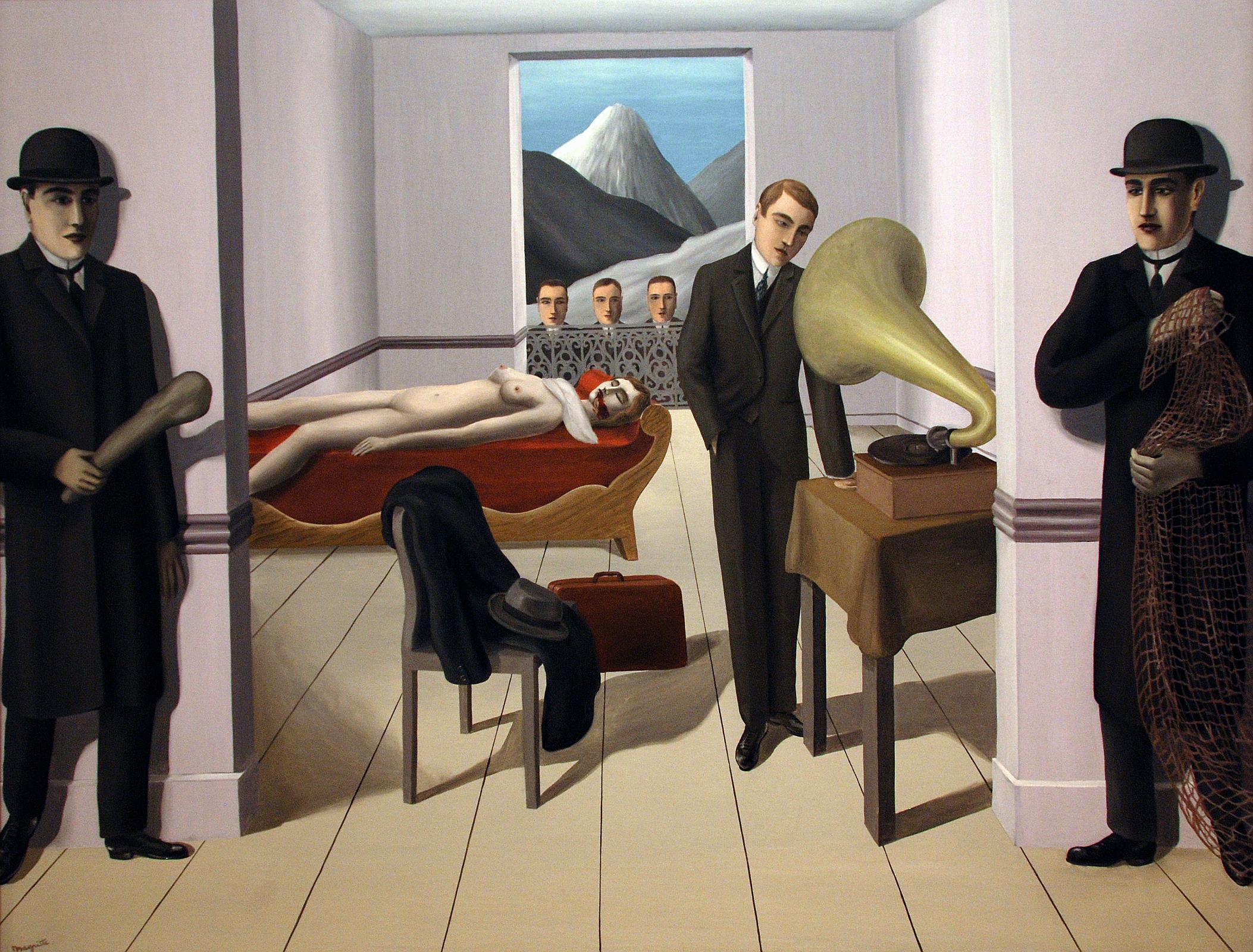
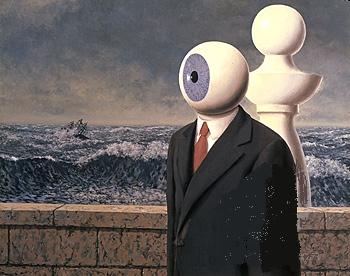
The game also is based on the idea that the player can create their own Disney universe, which will combine bits and pieces of all of the Disney texts that particular player enjoys. This creates a surreal atmosphere that reflects the postmodern ideas we discussed in class. Specifically, it reminded me of the work of Rene Magritte and his work with simulacrum. Many of his paintings—including the famous The Treachery of Images, more commonly known as “This is Not a Pipe”—combine elements of everyday life in odd ways, emphasizing that his paintings are by no means reality. Magritte’s floating people seem to have a direct relationship to the floating elements created by players in the game, such as a bistro hanging mid-air in the middle of a Disney-esque forest. Because the symbol and sign of the thing do not equal reality, both Magritte and this game use that fact to play around with these elements and create something surreal and fantastic.


The interactivity available in the game is also a fascinating consequence of the rejection of treating the game world like the real world. The players can explore the world at their own pace and do ridiculous things with the objects around them—like picking up other people. Additionally, players can manipulate the timeline of the game to suit their interests and whims. Lastly, the glitches and physics of the gae let the players, through their avatar, manipulate that reality even further. This has the same effect as described above—the symbol of the thing is not the thing, and consequently the players can do what they like with it.


Overall, the interactive experience of the game played with the whole “unreality” that games and media inevitable possess. The acknowledgment of this simulacra allows for experimentation and exploration that is inherent in children’s play. This game reality, through its lack of reality and heightened interactivity, provides a space for skill development, competition, mimicking, and pleasure needed for a child’s progress.

Tuesday, March 3, 2015

Book Analysis 2: I Am the Cheese

Robert Cormier’s I Am the Cheese is technically listed as a crime novel. The book is written in parallel narratives—one a first-person account of a boy running away to visit his father, and the other written as a transcript of therapy/interrogation sessions. The story covered in the transcript grows with gripping intrigue as Adam learns that his life is nothing that he thought it was, and that he is not the person he believes he is either. The unfolding of this grand scheme of organized crime, hidden identity, and a search for justice is exciting and will extend the imagination of readers. However, more valuable is the other narrative—a smaller, simpler story of one boy’s attempt to faces daily fears and anxieties. Life is hard, and disenchantment understandable. This story emphasizes that daily challenges are often the most frightening, forcing the struggles of the real world on the reader. However, by placing this next to a narrative that is on a much grander level Cormier paints these mundane struggles as noble and validates their difficulty.

The opening scene in the novel is one that many children have experienced—the exhilarating and terrifying feeling of riding quickly on a bike. Adam has thirty-five dollars, a dilapidated bike, and he didn’t take his medication that morning. This moment illustrates the extent of power children can create, and the simultaneous fear it creates. The next chapter introduces the next narrative—the transcript—and immediately that narrative is imbued with a feeling of spookiness, urgency, and panic. Adam recalls he and his father running away, and they don’t even know what from. These first two scenes, despite their differences in scale and tone, connect to each other in many ways. First, there is the feeling of running away from something you don’t understand. In the transcript that is played out quite literally. In the narrative, however, it is more cloudy and consequently more true to life. Adam thinks of everything he is leaving behind—a bad grade, his isolating interest in  Thomas Wolfe, his exciting but nervous relationship with Amy, and his dependence on medication. These fears look miniscule compared to the menacing threat that causes his family to flee in the other narrative, but because they are placed next to each other means that the same tone is applied to each.

This pattern continues throughout the book. When, in the transcript, Adam discovers that his family has a hidden identity and that he is, in fact, Paul Delmonte, the next thing that happens in the narrative is Adam realizing his bike has been stolen. Again, comparatively a stolen bike is miniscule in the context of lies and alternate identities, but the parallel pattern of the narrative validates the urgency of the stolen bike. For a child, the fear of a stolen bike is very real—as real as the secrets of the Farmer family. As another example, when Adam and his family again are forced to run toward the end of the book, the story happening in the other narrative Adam arrives in Belton Falls and experiences the fear of being there alone, at night, with strangers all around. The uncertainty in both of these events is the same.


At the end of the book these narratives meet together. In the story told through the transcript, Adam reveals that his parents were murdered (though it was staged to look like a car crash). The illusion surrounding the other narrative is then broken, and the adventure Adam has been experiencing is less exciting than ever—he has just been acting out his own delusions. However, the tragic solitude cause by his parents’ murder is here paralleled with Adam’s discovery that he “is the cheese”—a reference to the song “The Farmer in the Dell” and the line “the cheese stands alone.” Adam realizes that he is alone and has nobody. It’s a tragic end. The book does not soften the blow, but lets this loneliness stand. The hardships of the exciting crime story Adam reveals then pale in comparison to the realization everyone ends up having in life—that they are the cheese.

Saturday, February 28, 2015

Film Analysis 2: Mon Oncle

From the very opening of the film it is apparent that Jacques Tati’s Mon Oncle is not going to follow the standards of comedic filmmaking. The comedy is set in a world of heightened reality, where one side of the town is an idyllic picture of rural France, and the other is the most “modern” neighborhood around, featuring architectural novelties and everything plastic. As the antics play out in a relaxed pace, the bounds of standard narration don’t impede on the pleasure of the story—character focus is fluid, and goals are just passing fancies. Through sound and dialogue, unique cinematography, and manipulation of setting, the experimentation in the film Mon Oncle reflects its theme that natural experimentation and mischief can bring family closer together.  

The sounds in Mon Oncle indicate the modern versus the organic, or in other words the bad and the good, and cue the audience to appreciate rural mischief of Hulot’s world over the rigid order of Arpel’s. Only when the scene is with the Arpels and their modern world are there obviously contrived sound effects featured, such as the fountain, the doorbell, and the breathing sounds in the factory. In Hulot’s neighborhood there is music and the organic sounds of birds tweeting and children laughing—as well as dialogue, which is treated as just another sound. The film uses this vague sound to draw attention to the mischief that is developing Hulot and Gerard’s relationship.
Additionally, the other sounds of the film consistently compete with the dialogue and often have more to do with the story at hand. For example, the obnoxious sound of water trickling from the fish fountain indicates the Arpel family’s pride and control. During the dinner party Hulot manages to break the fountain, and the trickling is even more chaotic and distracting than normal. This reflects the fact that Hulot is bringing in the organic mess of his world into the Arpel’s home—though in the last scene of the film it’s clear that this chaos will create a relationship between father and son. On the reverse, when Monsieur Arpel brings his fancy new car into Hulot’s neighborhood, the music that has always accompanied that area is, like the fountain, halted and restarted again and again as Arpel tries to parallel park his car between two carriages. The car is unwelcome in this world of fun, and the obsessively methodical way Arpel is parking is interrupting the natural pleasure of life.


Mon Oncle is told visually, and consequently the cinematography does its part in non-traditionally communicating comedy. The film does very little to methodically draw audience attention to certain elements, but rather lets the audience play with their own attention like Gerard playing with the village children. First, most of the shots are extremely wide, and from interesting angles. Rather than shooting things for their aesthetic appeal, Tati angles the camera in order to capture the most action possible for the longest amount of time possible. In one long shot the audience can see the entirety of Hulot’s apartment building. The shot lasts as long as it takes for Hulot to climb up the chaotically designed building to his own room. The film lets the audience follow their own interests in the scene. Consequently, the film plays out more like a comic strip—a frame of visuals plus a few sound effects—rather than a narrative film.


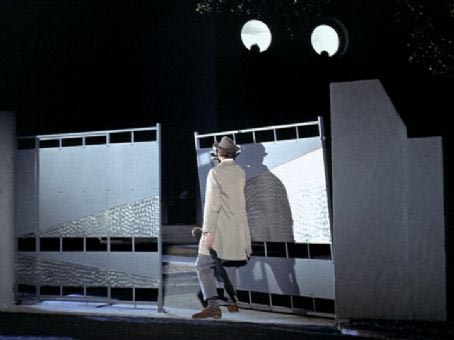
Lastly, Mon Oncle experiments with its environment, and combines tdiegetic and non-diegetic elements to create an atmosphere of mischief and fun. One notable moment is when Hulot is trying to finish trimming the bush, and wakes up the Arpels. The Arpel’s heads are silhouetted in their ultra-modern windows, making is appear as if the house has eyes and their heads are the pupils. They move in unison and consequently the house “looks around.” Hulot’s interaction with the environment is the most comedic element, such as when he is trying to use the kitchen. As mentioned before, the opening credits are all written on elements of the environment—signs and chalk drawings. This combination of diegetic and non-diegetic breaks the rules of traditional storytelling and reminds the audience that they are watching a constructed reality.


In the end, when Gerard and his father enjoy the results of a prank, Gerard grabs his father’s hand in a moment of affection. All of these moments that experiment with film form lead the audience to understand that this humor and clumsiness are what brought the family together.